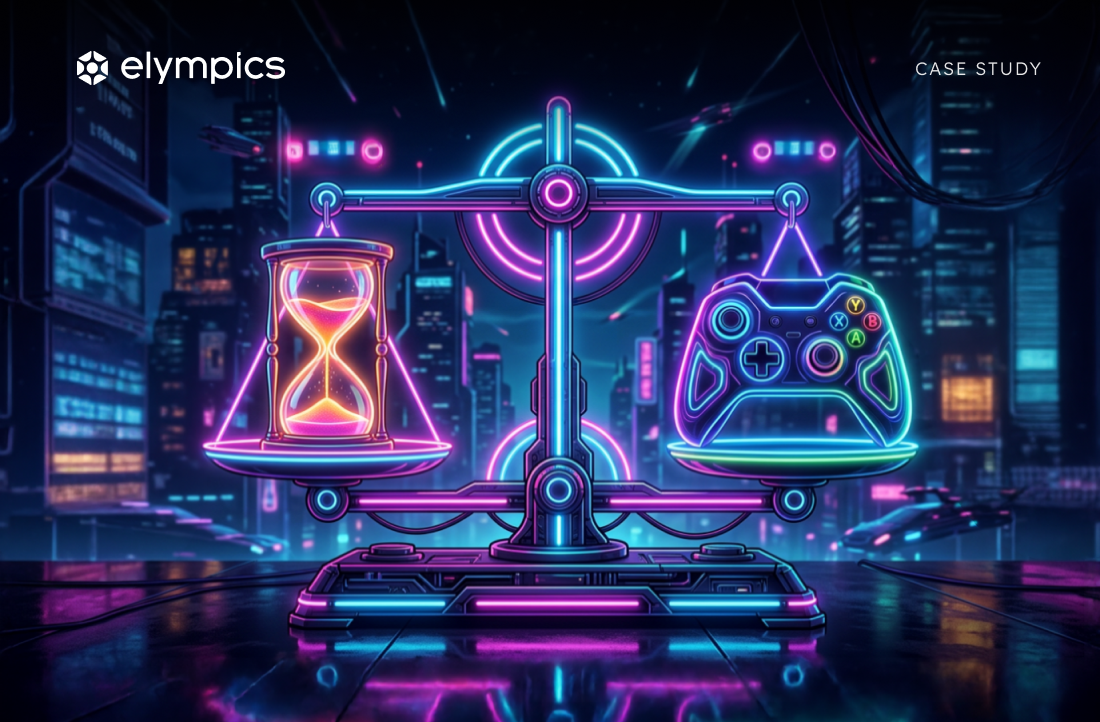
For years, progression in the world of gaming has followed a rather simple but widely accepted formula. The more time you invest, the more you progress. This structure has shaped entire ecosystems, from MMORPGs to competitive ladders, reinforcing the idea that player dedication is measured primarily in time.
At a surface level, this makes sense. Practice improves performance, familiarity builds confidence, and experience reduces mistakes. Yet somewhere along the way, time stopped being a major factor of improvement and became a proxy for skill itself. Systems began rewarding presence rather than performance, turning progression into something that could be accumulated rather than earned.
In competitive environments, this creates a significant distortion, since skill becomes harder to identify and players who improve quickly often move through systems designed for slower, time-gated advancement.
As gaming evolves toward performance-based ecosystems, particularly those enabled by on-chain infrastructure, this model begins to break down. The future of competitive gaming will not be defined by how long you play. Instead, it will be defined by how well you perform.
How Grinding Became the Default
The dominance of grind-based progression did not happen by accident. It materialized as a solution to retention challenges in early online games, where developers needed systems that encouraged players to return consistently over long periods of time.
In MMORPGs like World of Warcraft, progression is intentionally tied to time investment. Levels, gear, and endgame access require hours of repeated activity. Because of this, the system rewards persistence, creating a sense of long-term commitment that keeps players engaged for months or even years.
This philosophy extended into other venues of the gaming world. In competitive games such as League of Legends, climbing the ranked ladder often requires hundreds of matches, not because each individual game lacks meaning, but because variance and matchmaking systems smooth progression over time. The result is that a player may be highly skilled, yet still need dozens of games to reach an appropriate rank.
Even in shooters like Call of Duty, progression systems are layered with unlocks, experience points, and seasonal passes that reward time spent in-game as much as performance itself.
These systems may be effective at maintaining engagement since they create routines, establish goals to chase, and provide steady rewards that spike dopamine. However, they also blur the distinction between effort and mastery.
The Illusion of Progress
One of the reasons grinding remains so powerful to this day is psychological, or to put it more simply, it is human psychology that is being exploited.
Time-based progression creates a constant sense of movement, even when actual improvement is minimal, because systems continuously provide feedback in the form of levels, unlocks, badges, cosmetics, and visible milestones. That loop pushes players to continue the game, even when decision-making has not fundamentally changed. The result is an illusion of progress that can be satisfying in the short term, but misleading in competitive contexts.
This way, a player may spend dozens of hours repeating the same habits without refining strategy, improving adaptation, or learning to perform under pressure, and the system will still reward them. Experience points will accumulate over time, battle pass tiers will still unlock, and visible status in the form of badges will also increase.
This does not mean players are not improving at all, but it does mean that improvement is not required for progression to continue. In ecosystems where the goal is meaningful competition rather than retention for its own sake, that distinction really matters. When time investment and skill development are only loosely connected, systems struggle to distinguish between players who have mastered the game and players who have simply spent more time inside it.
Efficiency vs. Volume
This is where the real difference between players who grind and those who master the game gets visible.
A strong player is not just someone who has seen or played more matches, but someone who extracts more value from each match, adapting faster, recognizing patterns earlier, and correcting mistakes sooner. In other words, a strong player is someone who uses and acts on the feedback loop that creates iteration. As a result, such players need fewer repetitions to identify why they lost, fewer attempts to test a new strategy, and less time to reach a higher level of competence.
However, traditional progression systems often hide this efficiency behind the sheer weight of volume. A highly adaptable player may still need to grind through dozens of games because the system expects gradual movement, while a less efficient player can progress slowly through persistence alone and eventually reach similar visible milestones.
This creates a paradox where time becomes the dominant metric even inside systems that claim to reward skill and not time of hollow participation. The problem is not that time matters, because time will always matter to some degree, but that it becomes the primary signal, while performance is treated as something secondary, smoothed out over long enough horizons until the difference between talent, adaptation, and repetition becomes structurally blurred.
Why This Model Breaks in Competitive Ecosystems
As competitive ecosystems mature, the limitations of grind-based progression become more visible to both players and ecosystems.
High-skill players are met with unnecessary friction when they are forced to replay early stages repeatedly or grind through systems that do not respond quickly enough to genuine improvement. Matchmaking becomes inconsistent when volume-driven progression inflates rankings or delays corrections, while new players struggle to distinguish between genuine game mastery and merely an accumulated playtime.
Perhaps more importantly, grind-based systems discourage experimentation. When progression is tied to long-term accumulation, players are incentivized to default to safe, repeatable strategies rather than test new ideas that may carry short-term risk. This slows innovation and narrows the range of viable playstyles.
In earlier discussions about rapid learning cycles, we explored how short feedback loops accelerate skill acquisition by compressing action, consequence, and adjustment into dense sequences.
Grinding does the exact opposite.
It stretches feedback over long sessions, dilutes the impact of individual decisions, and often rewards endurance more than precision, resulting in slower adaptation and weaker skill expression.
Shift Toward Performance
This is where performance-based systems, especially those built on the on-chain rails, introduce a meaningful shift. Instead of rewarding time spent, they align rewards with measurable outcomes, making sure each match carries a real weight and each decision matters more in the grand scheme of player’s development.
Players can no longer rely on volume alone to progress. Instead, they must consistently perform on a high level, quickly adapt their actions, and refine their strategies in response to real consequences. Even the most boring of matches with little rewards reinforce this behavior, pushing players to engage more deliberately with the game rather than passively accumulating progress. It does not remove time from the equation - since we’ve already established time will always be a significant factor, but it reframes the value of time spent with the game entirely.
In this situation, time becomes an opportunity to perform rather than a guarantee of advancement, which fundamentally changes how players approach competition and improvement.
Infrastructure and Verifiable Skill
For performance-based systems to function at a larger scale, results players see and feel must be both trustworthy and persistent.
Without reliable infrastructure, performance loses its credibility and becomes just another metric that can be questioned or manipulated. On-chain ecosystems address this well-known issue by making match outcomes transparent, verifiable, and permanently recorded, allowing performance history to form the foundation of competitive identity. At Elympics, this approach shapes how competitive environments are built, with deterministic execution ensuring fairness, transparent tracking preserving outcomes, and cross-ecosystem compatibility allowing skill to carry across games. All this makes it possible to build systems where skill is not inferred indirectly through time spent, but is rather demonstrated directly through results.
Toward Meritocratic Competition
As gaming continues to evolve, the balance between time and skill will keep shifting. Grind-based systems will remain relevant in certain contexts, but in competitive environments, performance-based models will offer a clearer and more honest path forward.
Players who improve quickly should advance quickly, and players who perform consistently should be recognized consistently. That’s how things should be.
Systems should reflect ability rather than time-based availability, rewarding adaptation, decision-making, and execution instead of mere repetition. Time will always play a role in mastery, but its role is changing. In older systems, time acts as a substitute for skill, and there are historical reasons for it.
In future ecosystems, however, especially those supported by transparent and persistent infrastructure, time becomes the space in which skill is expressed and validated. Grinding will not disappear overnight, but its dominance as the primary measure of progress will continue to fade, replaced by systems that recognize what competition has always been about those who played the longest, but those who played the best.
- - - - - - - - -
Enjoyed this article? Dive deeper into the future of gaming by exploring more insights and stories on our blog. And if you wish to stay updated with announcements, game launches, and behind-the-scenes follow Elympics on X
Track your progress, reputation, and growth across every game - your journey starts in the Elympics Player’s Cockpit.